
Is This Anxiety or Intuition? How to Tell the Difference in Relationships
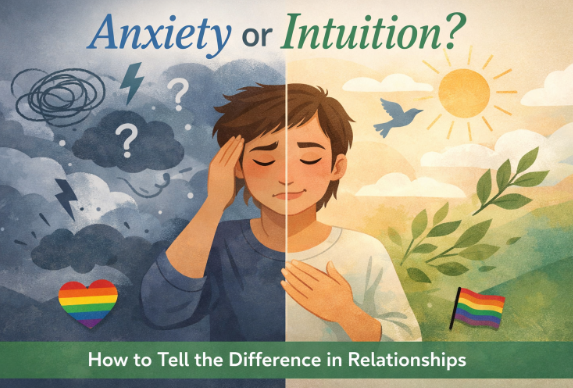
If you have ever found yourself asking, “Is this my gut feeling or am I just overthinking?” you are not alone.
Many people experience this kind of confusion in relationships. Something feels off, but it is hard to tell whether it is intuition trying to guide you or anxiety trying to protect you.
For many LGBTQIA+ adults, this question can feel even more complicated. When past experiences have taught you that connection can be uncertain, your mind may stay alert for signs that something is wrong.
Understanding the difference between anxiety and intuition can help you feel more grounded, more confident, and less stuck in the loop of second guessing yourself.
Anxiety Tends to Feel Urgent and Loud
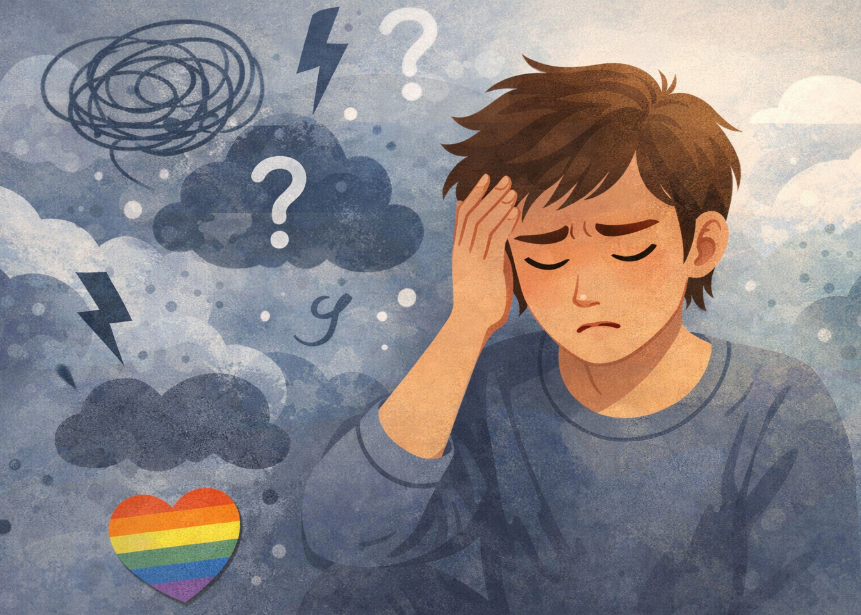
Anxiety often shows up with a sense of urgency.
It pushes you to figure things out right now. It asks a lot of “what if” questions and pulls your attention toward worst case scenarios. It can feel repetitive, looping, and hard to shut off.
Anxiety is focused on preventing something bad from happening. Even when there is no clear evidence, it can still feel very real in your body.

Intuition Is Usually Quieter and More Grounded
Intuition tends to feel different.
Instead of urgency, it often feels steady. Instead of a flood of thoughts, it may show up as a simple knowing or a consistent feeling that something does or does not feel right.
Intuition does not usually spiral. It does not need to convince you over and over again. It tends to be more calm, even when what it is telling you is uncomfortable.
Anxiety Looks for Proof, Intuition Feels Consistent
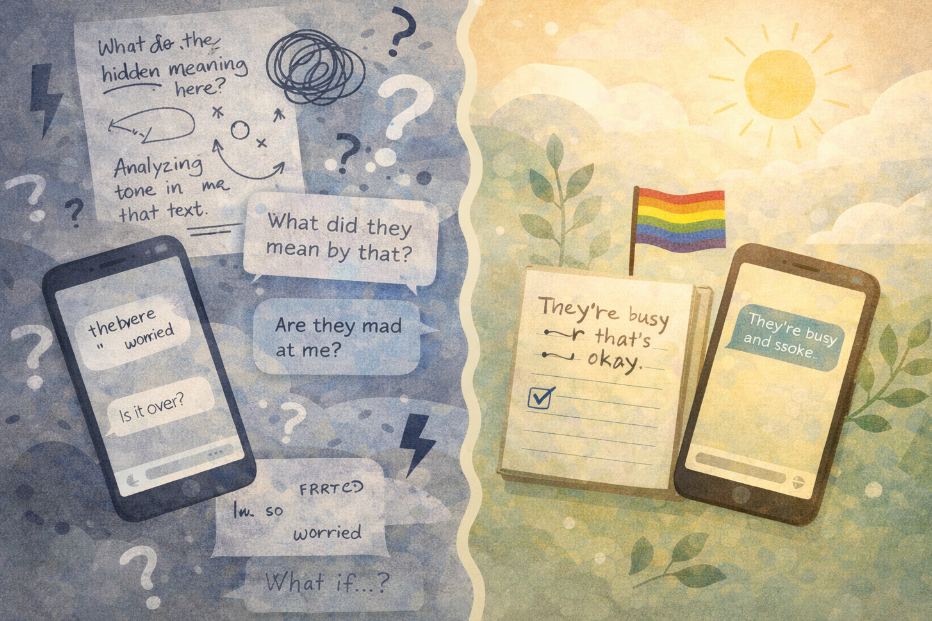
Anxiety often searches for evidence.
It scans texts, tone, and behavior, trying to confirm that something is wrong. It may jump from one possibility to another, constantly shifting as it tries to find certainty.
Intuition, on the other hand, tends to feel consistent over time. It does not rely on overanalyzing every detail. It is more about an overall sense of how something feels, rather than needing to prove it.

Past Experiences Can Blur the Difference
If you have experienced rejection, inconsistency, or emotional instability in relationships, it can become harder to trust your internal signals.
For many LGBTQIA+ adults, past experiences may have required being more aware of others’ reactions in order to feel safe or accepted.
Because of this, anxiety can start to feel like intuition. Your brain may treat any uncertainty as something to solve or prepare for, even when there is no immediate threat.

Learning the Difference Takes Practice
There is no perfect, immediate way to tell the difference every time.
This is something that develops over time. It often involves slowing down, noticing what is happening in your body, and becoming more aware of your thought patterns.
You might start to ask:
Does this feel urgent or steady?
Is this thought looping or consistent?
Am I reacting to a current situation or something from the past?
The goal is not to eliminate anxiety or rely only on intuition. It is to build enough awareness that you can respond thoughtfully instead of reacting automatically.
A Grounded Reminder
If you struggle to tell the difference between anxiety and intuition, it does not mean you cannot trust yourself.
For many people, especially LGBTQIA+ adults, this confusion comes from learning to navigate relationships in environments where safety and acceptance were not always consistent.
Your brain learned to stay alert for a reason.
With time and support, it is possible to build a stronger sense of internal trust. One where you can feel more confident in your instincts without getting pulled into constant overthinking.
A Gentle Next Step
If you are feeling stuck in cycles of overthinking, second guessing, or uncertainty in your relationships, therapy can help you better understand your patterns and build more confidence in your internal sense of knowing.
You do not have to figure this out on your own. Schedule a free consultation here.
